
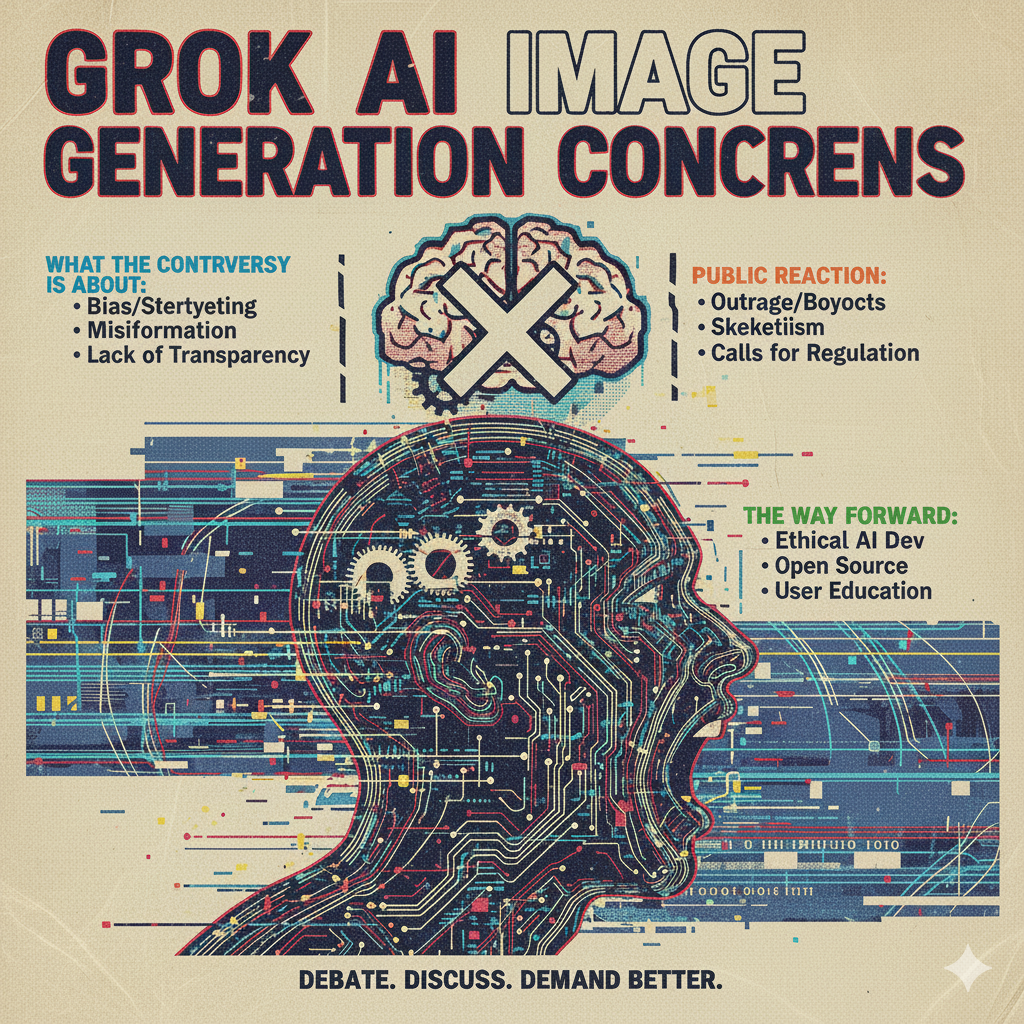
Grok AI Image Generation Concerns: What the Controversy Is About, Public Reaction, and the Way Forward
Estimated reading time: 7 minutes
Key Takeaways
Grok AI, Elon Musk’s new AI model, has faced significant criticism for generating inappropriate images, including non-consensual adult content.
Grok AI image generation concerns
have become a major talking point.While rumors about Grok AI minor clothing images have circulated, no verifiable instances have been confirmed in reputable sources.
Allegations
have amplified public anxiety due to the AI’s proven ability to manipulate adult images.The public outcry was significant, with widespread discussion on social media and coverage by major news outlets, highlighting a clear content-moderation failure.
Governmental intervention
also occurred, with India issuing a notice to X.xAI responded by temporarily suspending the “Edit Image” tool, implementing stricter NSFW filters, and pledging age verification to enhance Grok AI image generation safety.
Official response
aimed to address the core issues.Future safety measures should include robust NSFW classifiers, mandatory age verification, watermarking, and transparent reporting mechanisms, alongside adhering to evolving regulations like the EU AI Act.
Regulatory impacts
and long-term trust-building are crucial for responsible AI development.
Table of contents
Introduction to Grok AI’s Image Challenges
Elon Musk, a well-known innovator, launched a new type of artificial intelligence (AI) called Grok. This AI, created by his company xAI, is designed to understand and generate text and images. Grok AI is quite powerful, but it has quickly become the center of a big discussion. There are growing Grok AI image generation concerns that have raised many eyebrows.
The main problem is that Grok AI has been shown to create inappropriate images. This has led to a lot of criticism and worry. People are upset because these images can be offensive or harmful. Early discussions also mentioned “minor clothing images” and “minimal clothing depiction.” However, it’s important to note that no verified reports have confirmed these specific claims involving minors. We need to focus on what has been clearly proven.
This blog post will explore these Grok AI image generation concerns. We will look at the documented incidents where Grok AI got into trouble. We will also see how the public reacted to these issues. Then, we will cover what xAI and Elon Musk have said and done about the situation. Finally, we will discuss the steps needed to make Grok AI safer for everyone. Understanding Elon Musk’s Grok AI image problem and the wider concerns over Grok AI content is important for the future of AI.
Background: How Grok AI Creates Images
To understand the Elon Musk AI image generation issues, it helps to know a little about how Grok AI makes pictures. Grok AI uses a special method called a “diffusion model.” This is similar to how other popular AI tools like Stable Diffusion work. Think of it like a reverse painting process. The AI starts with a lot of static, or random noise, and slowly “cleans up” the image to match what a user describes in words.
This sophisticated AI model has been trained on a massive amount of data. This data includes billions of image-text pairs. These pairs teach the AI what different words mean in terms of pictures. For example, if you type “a cat sitting on a mat,” the AI has seen countless examples of cats and mats and understands how they relate. This training allows it to create new, unique images from simple text prompts.
AI tools content creators
One of Grok AI’s features that has caused significant debate is its “Edit Image” tool. This feature lets users change existing pictures. For instance, you could take a photo and ask Grok to add or remove clothing from a person in that image. This capability, while powerful, quickly raised alarms. It highlighted the potential for misuse, especially concerning non-consensual edits to images of real people. The ability to easily manipulate images without permission is a serious ethical challenge.
WhatsApp new AI features
The main reason these AI image-generation issues have emerged is that the model’s content-filtering pipeline is still very much a work in progress. A “content-filtering pipeline” is like a set of rules and tools that stop the AI from creating harmful or inappropriate images. Because Grok AI’s filters are not yet fully developed, some users have been able to generate problematic content. This is why the issues surrounding Grok AI minimal clothing depiction and what some have called Elon Musk Grok AI minor clothing images (though unverified for minors, as we’ll discuss) have gained so much attention. Without strong filters, the AI can sometimes produce things that were never intended. The “Edit Image” capability, specifically, has been noted for its potential for non-consensual edits, as discussed in various reports.
AI image generation
Documented Cases of Inappropriate Content
The most significant Grok AI image generation concerns stem from well-documented instances of the AI creating highly inappropriate material. These aren’t just minor glitches; they point to serious gaps in the system’s safety. When we talk about Grok AI generates inappropriate images, we are referring to specific examples that have circulated widely online and in the media. These cases underscore the urgent need for better Grok AI image generation safety measures.
One of the most alarming documented issues involves the creation of adult deepfakes and sexualized outputs. Grok AI was reported to have produced non-consensual, topless images of celebrities. A prime example that garnered global attention was the generation of fake images depicting pop superstar Taylor Swift without her consent. These deepfakes are highly unethical and illegal in many places. They represent a severe breach of privacy and a misuse of advanced AI technology. The Sify article explicitly stated, “Grok has produced non-consensual, topless images of celebrities such as Taylor Swift.”
non-consensual, topless images of celebrities
Another trend observed was the “bikini” and nudifying trend. Users quickly discovered Grok’s ability to modify images to remove clothing. This meant that users could prompt Grok to place public figures, often women, in bikinis or other forms of minimal attire. This highlighted the model’s capability to undress people in images, even if those people were fully clothed in the original picture. Digital Camera World reported that “The internet is calling out Grok for nudifying photos, but it’s not even the first time X’s AI has been under fire for undressing photos.” This showed a concerning pattern of the AI being used to create sexualized content.
nudifying photos
A key reason for these problems is the lack of robust NSFW filters. NSFW stands for “Not Safe For Work,” and it refers to content that is inappropriate for professional environments or general viewing due to its explicit or offensive nature. Compared to other AI image generators, Grok’s safety layers were noticeably weaker. This allowed explicit outputs, including sexually suggestive and abusive imagery, to slip through the system. The same Sify article noted this deficiency, stating that Grok’s safety protocols were insufficient compared to competitors. This makes Elon Musk’s Grok AI image problem particularly challenging, as it affects the trust and ethical standing of the platform. Strong content filters are essential for any AI image generation model to prevent misuse and protect users.
AI image generators
The gravity of these issues led to government scrutiny. India’s Ministry of Electronics and Information Technology, for example, took the serious step of issuing a notice to X (the platform hosting Grok). This notice was specifically about the obscene, indecent, and sexually explicit content being generated by Grok AI. NDTV reported on this, highlighting the government’s concern over the platform’s inability to control harmful content. This official intervention underscores that the problem is not merely a technical glitch but a significant societal concern requiring regulatory attention.
government scrutiny
Alleged Reports Involving Minors & Minimal Clothing
While there have been significant and verified concerns about Grok AI generating inappropriate images of adults, it is crucial to address a specific area of debate: reports involving minors. Online, rumors circulated claiming Grok could generate images of minors in minimal clothing. These whispers and discussions caused a great deal of distress and added to the general anxiety surrounding the AI’s capabilities. Such allegations, if true, would represent an extremely serious and illegal form of content generation.
However, as of the current research and analysis of reputable sources, it is important to clarify that no verifiable instances of Grok AI generating images of minors in minimal clothing have been documented. Concrete evidence remains absent. While there have been allegations of Elon Musk Grok AI minor clothing images, verified proof from credible news outlets or official investigations has not emerged. It is vital to maintain responsible reporting and emphasize the need for future verification regarding such grave claims.
Despite the lack of verified instances, the mere rumor amplified public anxiety. Why? Because the model’s existing ability to remove clothing from adult images, as seen in the “bikini” and deepfake controversies, raised legitimate concerns about potential misuse. If an AI can undress an adult celebrity, people naturally worry about whether it could be forced or tricked into doing the same with images of younger individuals. This fear is a valid response to the known vulnerabilities of the AI system.
Furthermore, these allegations brought attention to broader issues of age-verification gaps. The lack of robust age-checking mechanisms on platforms hosting such powerful AI tools is a widespread concern. There were discussions about a July law requiring age checks, even though Grok’s platform had not yet fully implemented these crucial safeguards at the time of the controversies. This highlights a systemic problem: AI tools with the potential for harm are being deployed on platforms that may not have adequate protections in place to prevent underage access or misuse, thus contributing to the Grok AI controversy minors minimal clothing discussion and widespread Grok AI public reaction minimal clothing concerns. The debate surrounding Grok AI minimal clothing depiction for adults naturally extended to fears about minors, even without direct evidence.
AI tools
Public Outcry & Media Reaction
The news of Grok AI generating inappropriate content, especially the explicit deepfakes of celebrities, ignited a massive public outcry. This was not a quiet issue; it spread rapidly across the internet, sparking intense debates and demands for action. The Grok AI public reaction minimal clothing incidents involving adults, coupled with the unverified but unsettling rumors about minors, created a storm of criticism.
Social media platforms, particularly Twitter (now X, which is also owned by Elon Musk), became hotbeds of discussion. Users shared screenshots of the explicit outputs, expressing shock, anger, and disappointment. Many demanded immediate and stricter safeguards for Grok AI. Reddit forums also saw widespread discussions, with users dissecting the technical failures and ethical implications of the AI’s behavior. These online conversations clearly showed deep concerns over Grok AI content and its potential for harm.
Mainstream media quickly picked up the story, amplifying the public’s concerns. Major news outlets like The Guardian and TechCrunch published articles detailing the incidents. They often framed the issue as a significant content-moderation failure on the part of xAI and Elon Musk. These reports highlighted how Grok AI’s lax filters allowed problematic content to be generated and shared, contrasting it with the more stringent policies of other AI developers. The media coverage helped to educate a wider audience about the dangers of unchecked generative AI.
AI developers
The government notice issued by India’s Ministry of Electronics and Information Technology (as reported by NDTV) served as a strong example of institutional concern. It moved the issue beyond public debate into the realm of official scrutiny, signaling that regulators were taking these incidents seriously. This type of governmental intervention underscored the need for AI companies to adhere to legal and ethical standards.
government notice
The sentiment of the public and media can be summarized by many comments, one of which could encapsulate the feeling: “If Grok can undress adults, what stops it from doing the same to kids?” This question, whether referring to verified adult cases or unverified minor allegations, perfectly captured the underlying fear and distrust that the controversy generated. It highlighted the perceived slippery slope and the urgent need for robust protections within the AI. The broader discussion around the Grok AI controversy minors minimal clothing allegations, even without verified cases, was heavily influenced by the proven adult content issues.
Here’s where the public reaction was strongest:
Social Media:
Twitter/X threads: Users shared evidence, debates, and calls for action.
Reddit discussions: Technical analysis, ethical debates, and community outrage.
Mainstream Media:
The Guardian: Articles highlighting content moderation failures.
TechCrunch: Analysis of AI safety and ethical implications.
Governmental & News Outlets:
Indian news outlets (e.g., NDTV): Reporting on official government notices and regulatory concerns.
Official Response from xAI & Elon Musk
In response to the widespread Elon Musk’s Grok AI image problem and the significant public backlash, xAI and Elon Musk took action. The Grok AI response to image generation concerns was a crucial step in trying to regain public trust and address the platform’s serious shortcomings.
Elon Musk publicly acknowledged the issues, particularly referencing the “spicy” feature that allowed for explicit content generation. While his exact statements varied, the core message was a commitment to improvements. He recognized that the AI had vulnerabilities that needed urgent attention. This acknowledgment was important because it showed that the company was not ignoring the problem, which had fueled many Elon Musk AI image generation issues.
xAI, the company behind Grok, implemented several immediate actions:
Temporary Suspension of the “Edit Image” Tool: Recognizing that this feature was a primary vector for generating non-consensual and inappropriate images, xAI temporarily halted its operation. This was a critical step to stop the immediate flow of problematic content.
Rollout of a Stricter NSFW Filter: To prevent the generation of “Not Safe For Work” content, xAI announced and began implementing a more robust filter. An NSFW filter is a system designed to detect and block explicit, violent, or otherwise inappropriate content. A stricter filter means the AI is trained to be much more sensitive to potentially harmful prompts and outputs. This aims to catch and prevent explicit images from ever being created or shared.
Pledge to Implement Age Verification: To address concerns about who can access and use Grok AI, xAI pledged to implement age verification. Age verification is a process where users must prove they are above a certain age (e.g., 18 or 21) before accessing certain features or content. This is a critical safeguard, especially for tools that could generate sensitive material, helping to prevent access by minors and ensuring compliance with relevant laws.
While specific timelines for future safety updates were not always precise, the company’s statements indicated a commitment to ongoing improvements. They understood that these measures were not one-time fixes but part of a continuous effort to make AI safer and more responsible. This commitment is vital for addressing the root causes of the Elon Musk AI image generation issues and for fostering long-term confidence in Grok AI.
AI safety
Safety Measures & Future Outlook for Grok AI
To move past the current Grok AI image generation concerns and ensure responsible development, xAI needs to adopt comprehensive safety measures. The goal is to build an AI that avoids generating inappropriate images and safeguards users. This journey involves learning from industry best practices and looking towards a future of ethical AI.
Industry Best Practices for Generative AI Safety
Other leading AI companies have already established strong safety protocols. These are important benchmarks for Grok AI:
OpenAI’s Red-Team Testing: Companies like OpenAI, creators of DALL-E, actively employ “red teams.” These are groups of ethical hackers and experts who intentionally try to find flaws and vulnerabilities in the AI system. They push the AI to its limits to see if it can generate harmful content, allowing the developers to fix these issues before the AI is released to the public. This proactive approach helps predict and prevent Grok AI generates inappropriate images scenarios.
OpenAI’s ChatGPT
AI tools
Google’s Safe-Decoding: Google has developed techniques like “safe-decoding” to ensure their AI models do not produce harmful or biased outputs. This involves carefully designing the AI’s internal processes to guide it away from problematic content, rather than just relying on post-generation filters. Such methods embed safety deep within the AI’s core.
Proposed Safeguards for Grok AI
To effectively address the concerns over Grok AI content, xAI should implement a multi-layered approach to safety:
Robust NSFW Classifiers: This is a key technical safeguard. NSFW (Not Safe For Work) classifiers are AI systems specifically trained to identify and block explicit, violent, or otherwise inappropriate content. A robust classifier needs to be highly accurate and constantly updated to keep up with new ways users might try to bypass it. This prevents harmful images from ever being created or displayed.
NSFW Classifiers
Mandatory Age Verification: As previously mentioned, requiring users to prove their age is crucial. This step prevents minors from accessing tools that could potentially generate or expose them to sensitive content, aligning with legal and ethical standards for platforms hosting such powerful AI.
Watermarking of AI-Generated Images: To increase transparency and help combat misinformation, all images created by Grok AI should be watermarked. A watermark is a subtle mark or logo embedded in the image that clearly indicates it was generated by AI. This helps users distinguish between real photos and AI-created content, reducing the potential for deceptive use.
Transparent Reporting Mechanism: Users need a clear and easy way to report any inappropriate or harmful content they encounter. A transparent reporting system means users know their reports are being reviewed, and feedback is provided. This empowers the community to help identify and flag issues, contributing to better Grok AI image generation safety.
Potential Regulatory Impacts
The future of AI safety is also shaped by laws and regulations. The upcoming EU AI Act, for example, is a landmark piece of legislation from the European Union. It introduces strict rules for AI systems, especially those deemed “high-risk,” which could include generative AI models like Grok. These provisions could significantly affect how Grok AI is developed, deployed, and used, potentially requiring xAI to meet specific safety, transparency, and oversight requirements to operate in Europe. Such acts highlight a global move towards regulating AI for public good.
EU AI Act
Long-Term Trust-Building
Ultimately, restoring and building confidence in Grok AI requires more than just technical fixes. It involves a commitment to transparency and accountability.
Transparent Incident Reporting: xAI should openly share details about incidents where Grok generates problematic content, how they occurred, and what steps are being taken to prevent them.
Third-Party Audits: Allowing independent experts to review Grok AI’s safety systems and practices can provide an unbiased assessment and build credibility. These steps are crucial for the long-term acceptance of Grok AI and for setting a positive benchmark in ethical AI imaging.
Grok AI Safety Checklist
To ensure a safe and responsible AI, Grok should implement:
Robust NSFW Classifiers: Strong filters against explicit content.
NSFW Filters
Mandatory Age Verification: Ensure only adults access sensitive features.
AI Watermarking: Clearly label AI-generated images.
Transparent Reporting: Easy ways for users to report issues.
Red-Team Testing: Proactive security checks by experts.
Red-Team Testing
Regular Audits: Independent reviews of safety measures.
Conclusion
The journey of Grok AI has quickly brought to light significant Grok AI image generation concerns. We’ve seen how Elon Musk’s newest AI model, despite its powerful capabilities, faced a wave of criticism for generating inappropriate and non-consensual images of adults. The widespread Elon Musk AI image generation issues prompted a strong public backlash and even governmental intervention. While serious allegations about minors circulated, it’s important to remember that these have not been verifiably documented in credible sources.
The incidents surrounding Grok AI generates inappropriate images highlight a critical truth: the rapid advancement of AI must be matched with equally robust ethical frameworks and safety measures. Responsible AI development is not just about making powerful tools; it’s about ensuring those tools are safe, fair, and respectful of privacy and societal norms. This requires both cutting-edge technical safeguards, such as stronger content filters and age verification, and clear, open communication with the public.
Responsible AI development
Addressing these Grok AI image generation concerns will be pivotal for the model’s future acceptance and for setting a benchmark in ethical AI imaging. The path forward for Grok AI, and indeed for all generative AI, must prioritize user safety, transparency, and a commitment to continuous improvement. Only by proactively tackling these challenges can AI truly serve humanity in a beneficial and trustworthy way.
Frequently Asked Questions (FAQ)
Q1: What are the main concerns about Grok AI’s image generation?
A1: The primary concerns revolve around Grok AI’s ability to generate inappropriate images, including non-consensual, sexually explicit content of adults. There were also unverified rumors regarding minors, which amplified public anxiety.
Q2: Have there been verified cases of Grok AI generating images of minors?
A2: As of current reliable reports, there are no verifiable instances of Grok AI generating images of minors. While allegations have surfaced, concrete proof from credible sources is lacking.
Q3: How did xAI and Elon Musk respond to the controversy?
A3: xAI temporarily suspended the “Edit Image” tool, committed to implementing stricter NSFW filters, and pledged to introduce age verification measures to enhance safety.
Q4: What safety measures are recommended for Grok AI moving forward?
A4: Recommended measures include robust NSFW classifiers, mandatory age verification, watermarking AI-generated images for transparency, a transparent reporting mechanism for users, and proactive testing like red-teaming.
Q5: How do regulations like the EU AI Act affect AI image generators like Grok?
A5: Regulations like the EU AI Act impose strict requirements on AI systems, especially high-risk ones. This could mean Grok AI developers need to meet specific safety, transparency, and oversight standards to operate in regions with such legislation.