
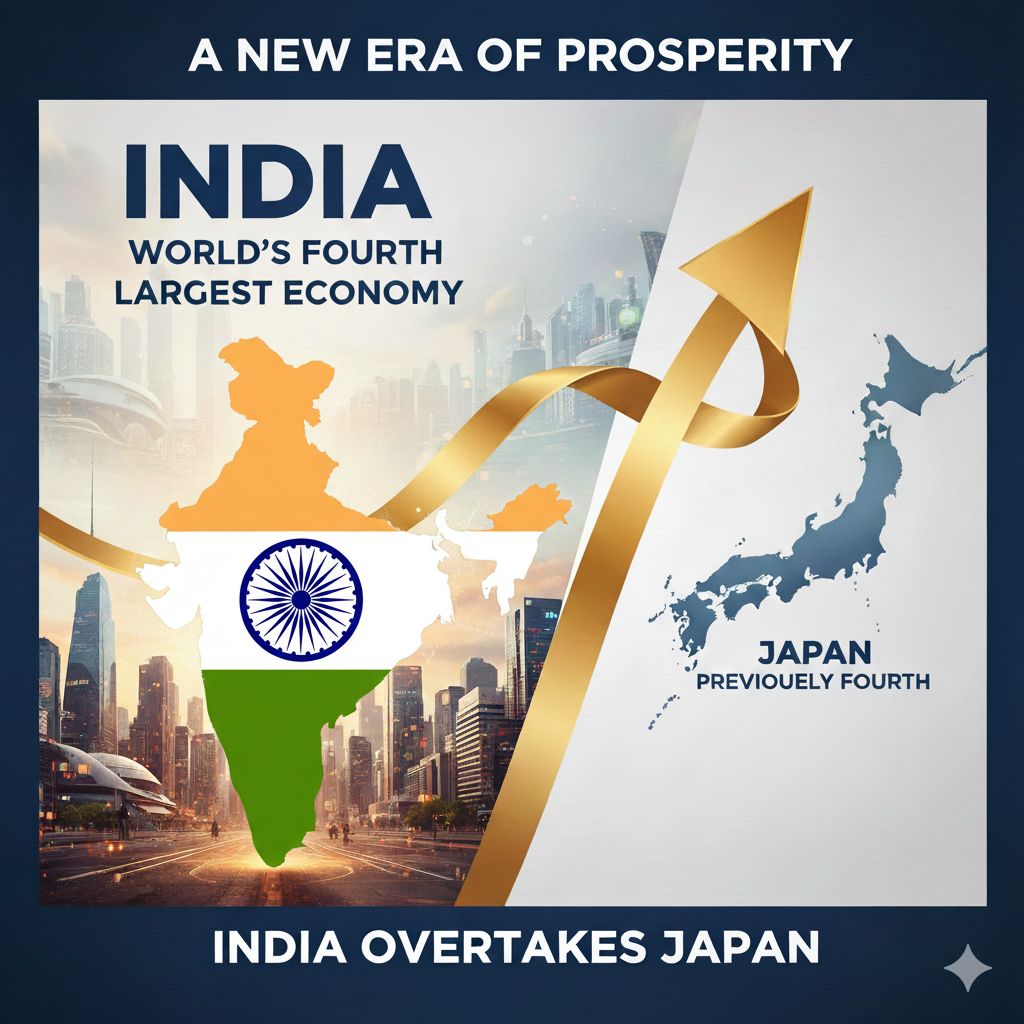
India Overtakes Japan: What Becoming the World’s Fourth Largest Economy Means
Estimated reading time: 10 minutes
Key Takeaways
- India surpasses Japan as the fourth largest economy globally based on nominal GDP.
- This landmark achievement signifies a major shift in global economic power dynamics.
- India’s economy is valued at approximately USD 4.18 trillion, overtaking Japan’s ~USD 4.0 trillion.
- Key drivers for India’s growth include its demographic dividend, strong domestic consumption, policy reforms, digitalization, and infrastructure investment.
- Japan, while still a developed economic powerhouse, faces structural challenges like an aging population and deflationary pressures, leading to slower growth.
- While India leads in nominal GDP, Japan still boasts a significantly higher GDP per capita, indicating a higher standard of living for its citizens.
- India’s rise is expected to influence global trade, investment flows, and geopolitical alliances.
Table of contents
- India Overtakes Japan: What Becoming the World’s Fourth Largest Economy Means
- Key Takeaways
- The Landmark Shift: India’s Ascent to Fourth Largest Economy
- Understanding India’s New Economic Ranking
- Core Drivers of Growth
- Recent Performance Metrics
- Contextual Comparison
- Japan’s Evolving Economic Position
- Current Status
- Structural Challenges
- Why “Japan Economy Overtaken by India” is a Growth-Rate Issue, Not a Collapse
- A Deeper Look: Japan vs India Economy Size
- Nominal GDP Comparison (2025)
- GDP per Capita
- Purchasing Power Parity (PPP)
- Sectoral Breakdown
- Global Implications of India’s New Ranking
- Geopolitical & Trade Impact
- Investment Flows
- Risks & Challenges
- Conclusion
The global economic map has undeniably shifted. In a truly landmark development, India surpasses Japan as the fourth largest economy, marking a significant moment in the world’s financial landscape. This remarkable achievement by India’s new economic ranking signals a powerful change in global power dynamics and economic influence.
This monumental economic milestone means India’s economy officially overtakes Japan’s with a staggering nominal Gross Domestic Product (GDP) of USD 4.18 trillion. This figure firmly establishes India as the Fourth largest economy in the world India. This shift holds immense implications for trade, investment, and how nations interact on the global stage. It’s a clear indicator of India’s growing economic might and its potential to shape the future.
The Landmark Shift: India’s Ascent to Fourth Largest Economy
The news has been met with significant attention worldwide. The Indian government has made an official announcement regarding this momentous achievement. While the International Monetary Fund (IMF) offers provisional acknowledgment, the final verification of this economic reordering is anticipated in 2026, when all annual GDP figures are officially compiled and released (https://www.japantimes.co.jp/news/2025/12/30/asia-pacific/india-economy-growth/). This provisional status does not diminish the immense significance of India’s progress.
This new ranking is specifically based on nominal GDP for the year 2025. India’s economy has reached an impressive USD 4.18 trillion. In contrast, Japan’s nominal GDP stands at approximately USD 4.0 trillion. This difference, though seemingly small, is incredibly significant. It definitively places World’s fourth largest economy India Japan in a new hierarchy.
This shift is more than just a change in numbers. It emphasizes that India has become the fourth largest economy in the world, moving ahead of Japan. Japan has long been recognized as a highly developed and technologically advanced nation. For India, a developing country with a vast population, to surpass such an established economic powerhouse is a testament to its rapid growth and burgeoning potential. This new position reshapes global economic discussions and highlights India’s rising influence on international trade and investment. It firmly establishes India economy ranking fourth largest on the global stage.
Understanding India’s New Economic Ranking
Understanding the forces behind India’s impressive climb to the fourth largest economy in the world India is crucial. A combination of internal strengths and strategic initiatives has propelled the nation forward. This section delves into the core drivers and recent performance that define India’s new economic ranking.
Core Drivers of Growth
India’s economic engine is powered by several robust factors that work together to create sustained and rapid expansion. These key drivers are foundational to the nation’s increasing prosperity and its ability to surpass Japan as fourth largest economy.
- Demographic Dividend: India boasts an incredibly young population. Over 650 million people are under the age of 35. This large, youthful demographic provides an expanding labor force. This means more people are entering the workforce, contributing to production, and earning incomes. This youthful energy is a powerful asset, fueling economic activity and innovation across various sectors. The country’s vast human capital is a major advantage. Source.
- Domestic Consumption: A rapidly expanding middle class is a significant factor in India’s growth story. As more people earn higher incomes, their purchasing power increases. This leads to a strong and growing demand for a wide array of goods and services, from everyday necessities to luxury items and digital products. This robust internal market provides a stable base for economic activity, making India less reliant on exports compared to some other economies. The appetite for new technologies, mobile services, and consumer goods is insatiable. Source.
- Policy Reforms: The Indian government has implemented several far-reaching economic reforms designed to stimulate growth and improve the business environment. Key initiatives include the Goods and Services Tax (GST), which unified India into a single market, simplifying taxation. The Insolvency & Bankruptcy Code streamlined processes for resolving financial distress, making it easier for businesses to operate and for creditors to recover funds. The “Make in India” initiative encourages both domestic and international companies to manufacture their products in India, boosting industrial output, creating jobs, and enhancing the nation’s manufacturing capabilities. These policies improve ease of doing business and attract investment. Source.
- Technology & Digitalization: India has embraced the digital revolution with remarkable speed. There has been rapid adoption of fintech (financial technology) solutions, making banking and payments easier and more accessible. E-commerce platforms are booming, connecting buyers and sellers across the vast country. Furthermore, India is making significant strides in artificial intelligence (AI) and other advanced technologies, particularly in its services sector, which is a global leader in IT outsourcing. This technological adoption enhances efficiency, creates new industries, and drives innovation. Source.
- Infrastructure Investment: The government has made substantial investments in modernizing the nation’s infrastructure. This includes building new highways, improving and expanding ports, and developing renewable energy projects. Better infrastructure reduces logistics costs, improves connectivity, and attracts further investment. These developments are crucial for supporting industrial growth, facilitating trade, and improving the quality of life for citizens. From smart cities to improved rural connectivity, these investments lay the groundwork for future economic prosperity. Source.
Recent Performance Metrics
India’s economic performance metrics underscore its impressive growth trajectory. The numbers speak for themselves, illustrating why India overtakes Japan world’s fourth largest economy.
- Q2 FY 2025-26 Real GDP Growth: India’s economy demonstrated exceptional strength, achieving an 8.2% real GDP growth rate in the second quarter of the fiscal year 2025-26. This was an acceleration from the robust 7.8% growth recorded in the first quarter of the same fiscal year (https://www.youtube.com/watch?v=Tu7csxk7pn0). This high growth rate highlights the dynamism and resilience of the Indian economy, reflecting strong underlying fundamentals and effective policy implementation. Source.
- Projected GDP 2030: Experts and government projections indicate a very bright future for India’s economy. The nation’s GDP is forecast to reach an astounding USD 7.3 trillion by 2030. This rapid expansion means India is potentially poised to overtake Germany for the third position in the global economic rankings within a mere 2.5 to 3 years (https://www.youtube.com/watch?v=Tu7csxk7pn0). This ambitious projection underscores the significant momentum and long-term potential of the Indian market, attracting considerable global attention and investment. Source.
Contextual Comparison
To truly grasp the significance of India’s current position, it’s helpful to see its journey in context. Over the past decade, India’s nominal GDP has shown a consistent upward trajectory. At the same time, Japan’s economy, while mature, has experienced periods of stagnation. This difference in growth rates is the key reason for the recent shift.
Imagine a mini-timeline from 2015 to 2025. A decade ago, Japan’s economy was significantly larger. However, as India consistently grew at a much faster pace, year after year, the gap began to close. India’s burgeoning population, rising consumption, and targeted reforms created a powerful growth engine. Meanwhile, Japan contended with its own set of economic challenges, leading to more modest growth. The point at which India’s nominal GDP crosses Japan’s represents the culmination of these divergent paths. This crossing point symbolizes India’s new economic ranking and solidifies that India economy ranking fourth largest is a result of sustained, high-speed economic expansion, leading to India firmly establishing itself as the fourth largest economy in the world India.
Japan’s Evolving Economic Position
While the focus is often on India’s ascent, it’s equally important to understand Japan’s current economic standing. Japan remains a global economic powerhouse, but its position is shifting. The country has now officially been recorded as having Japan loses fourth largest economy status in nominal terms. However, it’s crucial to understand that Japan still maintains its status as a major advanced economy, known for its technological innovation, high-quality manufacturing, and substantial global investments.
Current Status
Despite the change in nominal GDP ranking, Japan continues to be a vital player in the world economy. It possesses one of the highest GDP per capita figures globally, reflecting its developed status and high standard of living. The nation is a leader in high-tech industries, automotive manufacturing, and robotics. Its global influence through foreign direct investment and technological contributions remains strong. This shift simply reflects a change in the relative size of its economy when compared to rapidly growing nations like India, not a decline in its overall development or influence.
Structural Challenges
Japan’s economy faces several deep-seated, structural challenges that have contributed to its slower growth rate compared to India’s dynamic expansion. These issues are long-standing and require careful management.
- Aging Population: This is perhaps Japan’s most significant demographic challenge. Over 28% of its citizens are aged 65 or older. This means a shrinking workforce and a rising dependency ratio, where fewer working-age people support a larger number of retirees. This puts pressure on social security systems, healthcare, and limits the overall productive capacity of the economy. The dwindling youth population also affects domestic demand and innovation. Source.
- Deflationary Pressures: For many years, Japan has struggled with persistent low inflation, or even deflation (falling prices). While low prices might sound good, prolonged deflation can be harmful. It encourages consumers to delay purchases, hoping prices will fall further, which reduces demand and investment. This makes it difficult for businesses to increase profits and wages, leading to a stagnant economic cycle. The Bank of Japan has employed aggressive monetary stimulus to combat this, but with limited success. Source.
- Weak Yen Effects: A weaker Japanese Yen (its currency) can have mixed effects. While it makes Japanese exports cheaper and more attractive to international buyers, it also significantly increases the cost of imports. Japan is heavily reliant on imported energy and raw materials. A weak yen means higher costs for businesses and consumers, reducing their purchasing power and potentially slowing down economic activity within the country. This currency dynamic poses a challenge for maintaining domestic stability and growth. Source.
- Growth Model Limits: Japan’s traditional growth model, heavily reliant on high-tech exports and manufacturing, is facing increased global competition. Emerging economies are catching up in technological capabilities, and global supply chains are shifting. While Japan’s exports are still world-class, the pace of global economic change and competition from countries like South Korea, China, and now India, means that its historical growth drivers are less potent than they once were. This necessitates a re-evaluation of its economic strategies to find new avenues for growth.
Why “Japan Economy Overtaken by India” is a Growth-Rate Issue, Not a Collapse
It is critical to understand that the narrative of “Japan economy overtaken by India” is about relative growth rates, not a collapse of the Japanese economy. Japan’s GDP still experiences modest growth, typically around 1% annually. This is a respectable rate for a highly developed, mature economy.
The difference lies in India’s exceptional pace. India’s economy has been growing at a rate of over 7% annually, sometimes even higher. This significant disparity in growth rates over several years has allowed India to rapidly close the gap and eventually surpass Japan in terms of nominal GDP. Japan remains a strong, wealthy nation with a high standard of living and advanced industries. Its economic strength is still immense. The shift simply reflects India’s rapid expansion and its emergence as a major global economic force. The story is one of India’s rapid ascent rather than Japan’s decline. This contextual understanding is vital for a fair comparison of Japan vs India economy size.
A Deeper Look: Japan vs India Economy Size
To truly understand the economic landscape, we need to move beyond simple nominal GDP figures and explore other key metrics. While India has now surpassed Japan in nominal terms, the two nations represent vastly different stages of economic development. Let’s dive into the details of Japan vs India economy size.
Nominal GDP Comparison (2025)
| Economy | Nominal GDP (2025) | Ranking |
|---|---|---|
| India | USD 4.18 trillion | 4th |
| Japan | ≈ USD 4.0 trillion | 5th |
This table clearly illustrates the recent shift, confirming India’s position as the World’s fourth largest economy India Japan. This is based on current estimates and projections for 2025.
GDP per Capita
One of the most telling distinctions between the two economies is their GDP per capita. This metric measures the average economic output per person and provides insight into the standard of living and economic development level of a country.
- Japan: ≈ USD 40,000
- India: ≈ USD 3,000
This stark difference highlights that while India’s overall economic size is now larger, the average Indian citizen still has a much lower income compared to the average Japanese citizen. Japan is a developed nation with a highly affluent population and sophisticated infrastructure. India, on the other hand, is a developing economy with a massive population, and its wealth is still being distributed and built across its vast citizenry. This gap showcases the different stages of development and the long journey India still has in terms of per capita prosperity. Source.
Purchasing Power Parity (PPP)
Another crucial economic indicator is Purchasing Power Parity (PPP). PPP adjusts GDP figures to account for differences in the cost of living and inflation rates between countries. In simpler terms, it tries to answer: “How much can you buy with a dollar in India versus a dollar in Japan?”
When measured by PPP, India is already significantly ahead of Japan. PPP shows the real buying power of a country’s currency within its own borders. Due to lower costs for goods and services in India, its economy is effectively larger in terms of what its citizens can actually purchase domestically. International Monetary Fund (IMF) and World Bank data consistently show India’s economy ranking much higher when adjusted for PPP, often already placing it as the third largest economy globally by this measure. This indicates the vast internal economic activity and consumption power within India, making it an incredibly attractive market. Source.
Sectoral Breakdown
Looking at how each economy generates its GDP provides further insight into their structures.
- Services Share:
- India: ~55% of its GDP comes from the services sector. This includes a vast range of activities like information technology, financial services, healthcare, education, and tourism. India’s IT and business process outsourcing (BPO) industries are globally renowned, contributing significantly to its service-oriented economy. Source.
- Manufacturing:
- India: Manufacturing is a rapidly rising sector in India, driven by initiatives like “Make in India.” While it contributes a smaller percentage than services, its growth is robust, encompassing automotive, pharmaceuticals, textiles, and electronics. The government is actively promoting manufacturing to create jobs and reduce reliance on imports. Source.
This comparison highlights that while both countries have strong service sectors, India is actively pushing its manufacturing base to catch up, aiming for a more balanced economic structure. This detailed look at Japan vs India economy size clarifies the complexities beyond just headline numbers.
Global Implications of India’s New Ranking
India’s rise to become the fourth largest economy in the world India carries profound implications for the entire globe. This shift will influence geopolitics, trade patterns, investment flows, and even the future direction of global economic policies. It confirms that India’s new economic ranking is not just a domestic triumph but a global event.
Geopolitical & Trade Impact
The elevation of India’s economic status will undoubtedly reshape global power dynamics.
- Shift in G20 Dynamics: The Group of Twenty (G20) is a forum of the world’s major economies that addresses global economic issues. With a larger economy, India will naturally have a louder and more influential voice in discussions concerning global fiscal coordination, trade policies, and sustainable development. India’s perspectives on development, climate change, and global governance will carry greater weight, impacting decisions that affect billions worldwide. Its role as a bridge between developed and developing nations could also strengthen. Source.
- Supply-Chain Realignment: The COVID-19 pandemic exposed vulnerabilities in global supply chains, prompting many multinational firms to seek diversification away from over-reliance on a single country. India’s large domestic market, growing manufacturing capabilities, and stable economic environment make it an attractive alternative. We can expect to see more multinational corporations (MNCs) diversifying their production facilities to India, leading to a realignment of global supply chains. This shift could create more resilient and geographically diversified manufacturing networks, boosting India’s role in global trade and manufacturing. Source.
Investment Flows
A larger and more stable economy naturally attracts greater international capital. This is a critical outcome of India’s economic ascent.
- Foreign Direct Investment (FDI): India is expected to see a significant rise in Foreign Direct Investment. A larger market means more potential customers, and stable growth offers more predictable returns for investors. Furthermore, a rising economy signals confidence and opportunity to global corporations. Recent FDI statistics (while not specifically provided in the prompt’s research, general trends show increasing flows into India) consistently highlight India as a preferred destination for foreign capital. Investors are drawn to India’s burgeoning consumer base, its skilled workforce, and its improving business environment. This inflow of capital will further fuel infrastructure development, job creation, and technological advancement, reinforcing India’s growth cycle and confirming that India surpasses Japan as fourth largest economy. Source.
Risks & Challenges
While India’s trajectory is impressive, sustaining this growth and fully leveraging its new economic ranking requires addressing several critical challenges. These are areas where continuous focus and strategic planning are essential.
- Infrastructure Gap: Despite significant investments, India still faces a substantial infrastructure gap. While new highways and ports are being built, the sheer scale of the country and its population means that there’s still a huge need for better roads, reliable power, improved public transport, and advanced digital connectivity across all regions. Bridging this gap is crucial for efficient logistics, supporting industrial growth, and improving the quality of life. Source.
- Regulatory Consistency: While policy reforms have improved the ease of doing business, investors still seek greater consistency and predictability in regulatory frameworks. Frequent changes in regulations or delays in approvals can deter foreign investment and impact business operations. Ensuring a stable, transparent, and consistent regulatory environment is vital for maintaining investor confidence and attracting long-term capital. Source.
- Skill Development: India’s large, youthful population is a strength, but ensuring this demographic dividend translates into a skilled workforce is a continuous challenge. There is a need for substantial investment in education and vocational training programs to equip the youth with the skills required by modern industries, particularly in technology, advanced manufacturing, and specialized services. Bridging the skill gap is essential for maximizing productivity and innovation across the economy. Source.
Addressing these challenges systematically will be key to India not only sustaining its current ranking but also achieving its ambitious future growth targets.
Conclusion
The recent economic shift, where India overtakes Japan world’s fourth largest economy, marks a pivotal moment in global economic history. This achievement is a testament to India’s dynamic growth story, driven by a powerful combination of factors. Its massive and young population provides a robust labor force and a burgeoning consumer market. Strategic policy reforms have enhanced the business environment, while aggressive investment in technology and infrastructure has laid the groundwork for future expansion.
In contrast, Japan, while remaining a highly developed and advanced economy, faces the complexities of an aging population, persistent deflationary pressures, and the impacts of a weaker currency. The story is not one of Japan’s economic collapse, but rather India’s rapid ascent, powered by a much higher growth rate over the past decade. Source.
Looking ahead, the future outlook for India is exceptionally promising. With projected GDP growth poised to reach USD 7.3 trillion by 2030, India is on track to potentially become the world’s third-largest economy within the next 2.5 to 3 years. This rapid expansion solidifies India’s economy overtakes Japan’s as a powerful force in global commerce and finance.
This fundamental reordering of economic powers will have lasting effects on international trade, investment patterns, and geopolitical alliances. As Japan loses fourth largest economy status, the world will increasingly look to India for leadership and innovation. How will businesses, governments, and individuals adapt to a world where India is a top-four economic powerhouse? The answers to this question will define the global economic landscape for decades to come.