
Lord Vishnu Statue Destroyed in Cambodia – Unpacking the Real Story Behind the Border Demolition
Estimated reading time: 7 minutes
Key Takeaways
- The incident involved a modern Lord Vishnu statue erected in 2014.
- The statue was demolished by Thai military engineers on the disputed Thailand-Cambodia border, not in Cambodia itself.
- Thailand described the act as part of “area-management and security operations” to remove a symbol of an illegal territorial claim.
- India condemned the demolition, citing disrespect to Hindu heritage and global religious sentiments.
- The statue was not an ancient artifact or a registered heritage site, thus no restoration is planned.
Table of contents
- Lord Vishnu Statue Destroyed in Cambodia – Unpacking the Real Story Behind the Border Demolition
- Key Takeaways
- The Incident – What Exactly Happened?
- Location & Historical Context – Where Was the Statue Actually Destroyed?
- Significance & Impact – Beyond the Physical Damage
- Investigation, Legal Aspects & Future Steps
- FAQ Box – Quick Answers to Common Queries
Have you seen the shocking videos or read the alarming headlines about a Lord Vishnu statue destroyed in Cambodia? News traveled fast, causing a stir among people worldwide. Many were concerned about this damage to a sacred figure. It looked like an old, important statue had been suddenly broken.
But what really happened? Recent reports claim a Lord Vishnu statue destroyed in Cambodia, but the actual event took place on the disputed Thailand-Cambodia border. This important detail changes a lot about the story.
This blog post will help you understand the full truth. We will present verified facts, clarify exactly where this happened, and explore the big reasons behind it. We’ll also look at the political and cultural effects of this event. Prepare to learn the real story behind the reported destruction Vishnu statue Cambodia that caused so much concern.
The Incident – What Exactly Happened?
When news broke about the destruction of Lord Vishnu statue Cambodia, many thought it was an act against an ancient holy site. However, the true events paint a different picture, one tied to modern border tensions.
Fact Summary
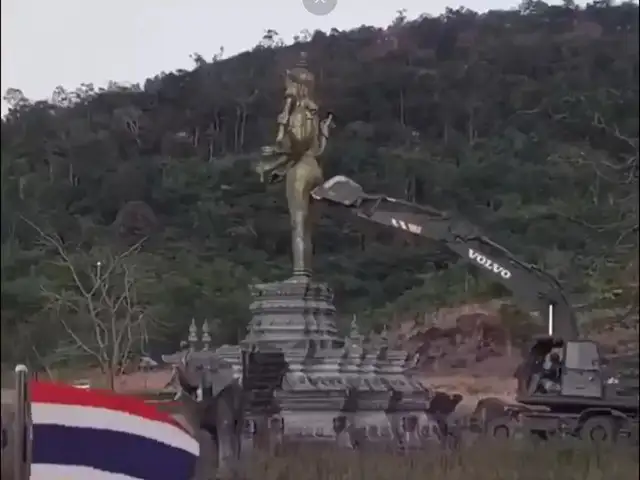
The statue in question was a modern Lord Vishnu figure. It was put up in 2014, not thousands of years ago. The figure was brought down on December 22, 2025. This act was carried out by Thai military engineers, who used a large digging machine called a back-hoe loader to do the job [1].
Soon after the demolition, videos of the destruction began to spread quickly. These clips circulated on Thai social media, showing the powerful machine breaking the statue [2]. Many people watched these videos, which only added to the confusion and worry around the world. The sight of a Vishnu statue being brought down was upsetting to many, especially those who hold religious beliefs for the deity. This immediate visual evidence made the incident feel very real and urgent to a global audience.
Cause & Context
The act of bringing down the statue was not random. It was part of bigger plans called “area-management and security operations.” These operations happened after Thai forces took back control of a contested area. This territory had been the site of fighting for about two weeks [1]. Border clashes had been ongoing, creating a very tense situation between the two nations.
Thai authorities quickly explained their actions. They said that the statue was just a “decorative structure.” They claimed it had been put there by Cambodian soldiers. Its purpose, they stated, was to try and show that Cambodia owned that piece of land [2]. This means the statue was seen not as a religious item, but as a political symbol. It was a marker in a long-running dispute over who controls the land.
The Thai government’s decision highlights the complex issues of territorial claims and national security. They viewed the statue as an attempt to unlawfully assert ownership over what they considered their land. Therefore, removing it was part of their military’s efforts to secure their borders and manage the disputed area effectively. This context is vital to understand why the statue of Lord Vishnu damaged Cambodia became a headline, despite its modern origin and specific location. The damage was a direct result of military actions in a highly sensitive border zone, not a random act against religious symbols.
Location & Historical Context – Where Was the Statue Actually Destroyed?
Many headlines said the Lord Vishnu statue destroyed in Cambodia. But this isn’t exactly right. The actual place is key to understanding the whole story. The location is an important piece of the puzzle that explains why this incident happened.
Exact Site
The actual place where the statue was destroyed is called Chong An Ma. This area is also sometimes referred to as the An Ses area. It sits right on the contested border between Thailand and Cambodia [1]. This border zone is near the famous Preah Vihear region, which has seen its own share of arguments over ownership.
Imagine a line drawn between two countries. Sometimes, both countries might claim a small piece of land along that line. That’s what a contested border means. It’s a place where two nations disagree about who owns the land. This particular border area has been a source of tension and occasional conflict for many years. The presence of military forces from both sides shows just how important and sensitive this strip of land is to both Thailand and Cambodia.
Why the “Cambodia” Misnomer?
So, why did so many news outlets say the Lord Vishnu statue damaged in Cambodia? It’s because the area where it happened is claimed by both nations. When something happens in such a disputed zone, news reports often pick one country to name, or simplify the location for easier understanding. This can sometimes lead to what we call a “misnomer,” or a wrong name.
Also, the way people search for news online plays a role. News organizations often use phrasing that helps people find their stories. This is called SEO-driven phrasing (Search Engine Optimization). Since “Cambodia” is often associated with ancient Hindu heritage sites like Angkor Wat, linking the statue destruction to Cambodia might have been seen as a way to get more people to read the news. It connected the event to a more widely recognized cultural context, even if the precise geographical detail was slightly off. This simplification, though common in news reporting, unintentionally caused some confusion about the exact location of the incident.
Historical Background of the Statue
It’s important to know that this statue was not an ancient artifact. Unlike the ancient Khmer statues found in famous temples, this Lord Vishnu figure was a modern installation. It was put up in 2014, meaning it was only about 11 years old when it was demolished [3]. This makes it very different from historical treasures. It was not a registered religious or heritage site, which means it wasn’t officially protected as an old, important landmark [1].
Lord Vishnu, a powerful god, has deep cultural meaning in many parts of Southeast Asia, including both Thailand and Cambodia. You can see many old, beautiful Vishnu statues in places like Angkor Wat in Cambodia, which are hundreds of years old. These ancient statues are respected and protected because of their long history and religious significance. However, this particular statue had a different story. It was placed in the border area in a time of modern territorial disputes. While Vishnu statues generally represent a shared civilizational heritage, this one’s recent origin and specific placement made it a part of the political landscape rather than solely a sacred object. This distinction is crucial when thinking about the Vishnu statue damage ancient Cambodia reports versus the reality of a modern monument caught in a border dispute. It wasn’t about damaging an ancient relic but about removing a recent symbol in a contested zone.
Significance & Impact – Beyond the Physical Damage
The demolition of the Lord Vishnu statue was more than just the breaking of a stone figure. It had many layers of meaning, touching on culture, religion, and the way countries interact. The act resonated far beyond the immediate border area, leading to strong feelings and reactions from different nations.
Cultural & Religious Implications
The demolition caused strong criticism, especially from India. Why? Because Lord Vishnu is a very important deity in Hinduism. He is seen as the preserver of the universe. For many, Vishnu represents a part of the region’s “shared civilizational heritage” [3]. This means that the worship and respect for Lord Vishnu have been present in this part of the world for a very long time, across different cultures and nations.
India’s Ministry of External Affairs quickly spoke out. They condemned the act, saying it was disrespectful to global religious sentiments [3]. This statement highlighted that hurting religious symbols, even if modern, can be seen as an insult to people of faith everywhere. It wasn’t just about one statue; it was about the respect for deeply held beliefs and cultural connections that transcend borders. The incident brought into focus the importance of protecting cultural and religious symbols, even in times of political tension. For many, the news Lord Vishnu statue destroyed was a sign of disrespect towards a shared sacred heritage.
Political & Security Dimensions
From Thailand’s point of view, the demolition was not about disrespecting religion. It was about security and national borders. Thailand explained that the statue was taken down to prevent it from being used as a “symbol of illegal territorial claim” [2]. In a disputed area, putting up a statue or any structure can be seen as a way to show ownership. This makes the territory even more complicated.
The demolition came after a period of intense border clashes that lasted for two weeks. These clashes involved military forces and unfortunately led to casualties. Such conflicts always create high diplomatic tension between the involved countries. Thailand’s military operations, including the removal of the statue, were aimed at securing the disputed zone and reinforcing their control over what they consider their land. For them, it was a necessary step in managing their borders and protecting their nation’s integrity. The decision was rooted in military strategy and geopolitical concerns rather than an attack on religious beliefs.
International Reaction
The incident drew attention from around the world. India’s condemnation was strong, emphasizing the disrespect to religious heritage. India urged both countries to resolve their differences through peaceful dialogue, highlighting the importance of the deity in the region’s shared history [3].
Thailand, in response to the criticism, defended its actions. Thai officials stated they respected Hinduism and its historical ties to the region [1]. They explained that the statue was considered a “decorative structure” placed there by Cambodian soldiers to make an illegal claim to the land [2]. Thailand’s Prime Minister even reportedly said that “a destroyed statue cannot compare to soldiers’ lives or limbs,” putting the lives of their soldiers above the statue’s preservation [2].
Cambodia’s public statements on this specific Vishnu statue were not widely detailed in the available news. However, Cambodia had previously accused Thai forces of damaging other temple ruins during recent border clashes, indicating ongoing tensions over heritage sites in the disputed areas [2]. This limited response shows the complexity and sensitivity of the situation. The incident became a matter of balancing national sovereignty against cultural sensitivities, leading to varying viewpoints and strong diplomatic exchanges. The reported destruction Vishnu statue Cambodia was a reminder of the delicate balance between nations.
Investigation, Legal Aspects & Future Steps
After an event like this, many questions arise about what happens next. Were there investigations? Will the statue be rebuilt? What does this mean for the future relationships between these countries? These are important aspects to consider for the statue of Lord Vishnu damaged Cambodia incident.
Ongoing Investigations
When it comes to the demolition of the statue, Thai authorities have been clear. They stated that the action was lawful under their military operations. This means they saw it as a legitimate act taken by their armed forces during a security situation. Because of this stance, no formal criminal investigation into the demolition has been announced by Thailand.
From their perspective, the military was simply carrying out its duty to protect the nation’s borders and manage disputed territory. This approach highlights how different nations view military actions in sensitive border zones. It suggests that they consider the demolition an operational decision rather than a crime or an act of vandalism. This military justification is key to understanding the official position on the incident and why no further legal action is being pursued by Thailand.
Restoration & Preservation Efforts
Since the statue was a modern structure, put up in 2014, it is not considered an ancient artifact. Because of this, there are no plans to restore or rebuild the specific statue that was demolished. This is different from how ancient temples or historical sites would be treated if damaged. For those, there would be strong calls and efforts to restore them carefully, piece by piece, to preserve their deep historical value.
However, this incident has sparked important discussions. It has led to calls for clearer rules and boundaries for heritage sites that are located in border areas. People want to make sure that ancient and truly historical monuments are protected, even when countries are arguing over land. This emphasizes the need for international agreements or clearer understandings about how cultural heritage should be handled in disputed zones, so that such issues do not contribute to future Cambodia Lord Vishnu statue damage. It’s about protecting the real historical treasures from similar fates, even if this particular statue won’t be rebuilt.
Potential Diplomatic Outcomes
The incident has certainly created tension. But it also presents a chance for countries to talk and work things out. There are possibilities for future dialogues between Thailand, Cambodia, and India. These talks could help prevent similar events from happening again. Thailand has already stated its pledge to respect Hindu heritage. However, they also firmly stand by their right to safeguard their sovereignty, meaning their right to govern their own land without interference.
These discussions could help draw clearer lines for disputed territories and agree on how to protect important cultural sites within those areas. The goal would be to find peaceful ways to resolve border disagreements while also showing respect for shared cultural and religious values. Such diplomatic efforts are essential to ensure that the destruction of Lord Vishnu statue Cambodia does not lead to long-lasting bitterness, but instead paves the way for better understanding and cooperation in the future. It’s about managing complex relationships and finding common ground where possible.
FAQ Box – Quick Answers to Common Queries
Q: Was the Lord Vishnu statue actually destroyed in Cambodia?
A: No, it was demolished by Thai forces on the disputed Thailand-Cambodia border, not within Cambodia itself. This important detail helps clarify the location.
Q: When was the statue built?
A: It was erected in 2014. This makes it a modern structure, not an ancient historical artifact.
Q: Why did Thailand demolish it?
A: Thailand stated it was part of “area-management and security operations.” They claimed the statue was used by Cambodian soldiers to assert an illegal territorial claim in a disputed zone.
Q: How did India react?
A: India condemned the demolition. They called it disrespectful to Hindu heritage and global religious sentiments, highlighting Vishnu’s importance as part of the region’s shared history.
Q: Will the statue be rebuilt or restored?
A: Since it was a modern structure and not a registered heritage site, there are no current plans for its restoration or rebuilding. The focus is more on preventing future incidents in disputed border zones.
Q: What is the significance of the “Cambodia” in the news headlines?
A: The term “Cambodia” was often used in initial reports because the area is claimed by both nations, and media sometimes simplify locations. It also links to the general region where Lord Vishnu is revered, though the exact site was contested. This created confusion, leading many to believe the news Lord Vishnu statue destroyed was specifically inside Cambodia.