
2025 Nobel Prize in Physics: Three Scientists Honored for Groundbreaking Work in Quantum Mechanics
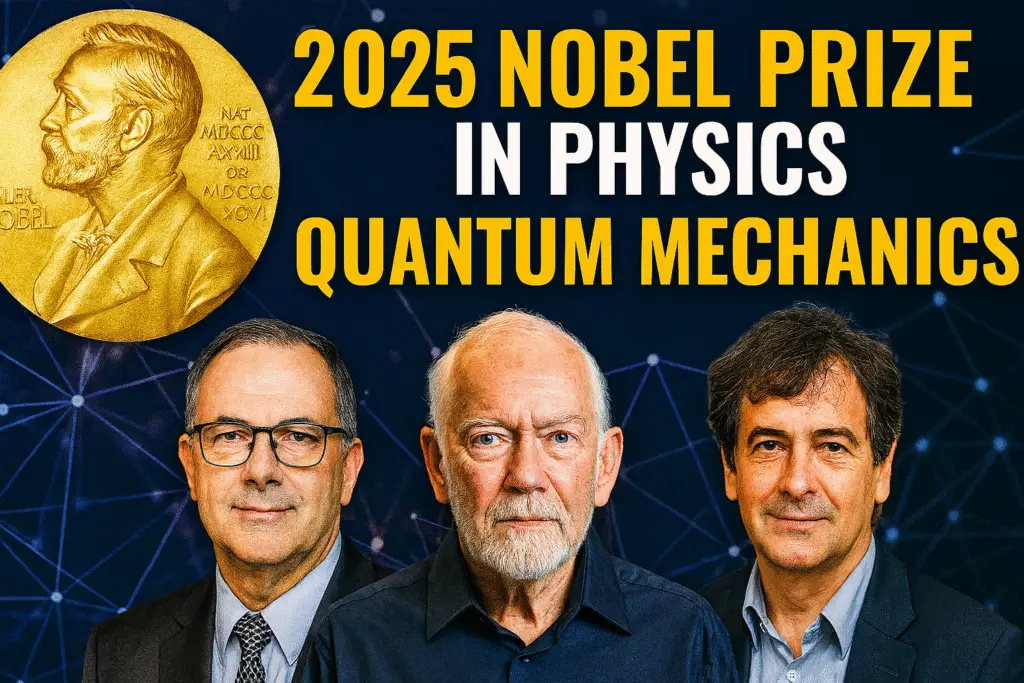
The 2025 Nobel Prize in Physics has been awarded to three scientists—John Clarke, Michel H. Devoret, and John M. Martinis—for their revolutionary discovery of macroscopic quantum mechanical tunneling and energy quantization in an electric circuit. The trio will share the prize money of 11 million Swedish kronor (approximately $1.2 million or ₹10.40 crore).
The Groundbreaking Discovery
The fundamental question these scientists addressed was: how large can a system be while still exhibiting quantum mechanical effects? In 1984 and 1985, working at the University of California, Berkeley, the three researchers conducted a series of experiments that demonstrated quantum properties in a system large enough to hold in one’s hand.
Their work centered on demonstrating quantum tunneling and energy quantization in an electrical circuit—a phenomenon previously thought to be observable only at microscopic scales involving individual particles. The researchers successfully showed that these quantum mechanical properties could manifest in a macroscopic system containing trillions of charged particles acting in unison.
Understanding Quantum Tunneling
Quantum tunneling is a phenomenon where particles pass straight through physical barriers that should theoretically block them—similar to a ball passing through a wall rather than bouncing back. While individual particles commonly exhibit this behavior, quantum effects typically diminish when large numbers of particles are involved.
The laureates’ experiments proved that under carefully controlled conditions, even macroscopic systems could maintain quantum behavior. This discovery challenged conventional understanding and opened new frontiers in quantum physics.
The Experimental Setup
Josephson Junctions
The scientists constructed their experiment using superconductors—materials that conduct electricity with zero resistance at extremely low temperatures. Their circuit consisted of two superconducting components separated by a thin insulating layer, an arrangement known as a Josephson junction (named after physicist Brian Josephson, who won the 1973 Nobel Prize for related work).
In conventional circuits, the insulator would prevent current flow entirely. However, in this quantum setup, charged particles (Cooper pairs) in the superconductor behaved collectively as a single quantum entity filling the entire circuit.
Observing Quantum Behavior
The system initially remained in a zero-voltage state, as if trapped behind an insurmountable barrier. Through quantum tunneling, the system escaped this state, which was detected by the appearance of voltage. The researchers also demonstrated energy quantization—the system absorbed and emitted energy only in specific discrete amounts, exactly as quantum mechanics predicts.
By introducing microwaves of varying wavelengths and meticulously measuring the system’s responses, they confirmed that this macroscopic circuit obeyed quantum mechanical laws.
Significance and Applications
Foundation for Quantum Computing
This discovery laid crucial groundwork for modern quantum computing technology. John Martinis later utilized the energy quantization principles from these experiments to develop quantum bits (qubits), where quantized energy states represent information as zeros and ones. Superconducting circuits based on Josephson junctions now underpin many quantum computer prototypes.
Next-Generation Technologies
According to Olle Eriksson, Chair of the Nobel Committee for Physics, “It is wonderful to be able to celebrate the way that century-old quantum mechanics continually offers new surprises. It is also enormously useful, as quantum mechanics is the foundation of all digital technology”.
The laureates’ work has opened pathways for developing quantum cryptography, quantum sensors, and advanced quantum computers—technologies that could solve problems beyond the reach of classical computers.
The Nobel Laureates
John Clarke was born in 1942 in Cambridge, UK, and completed his PhD at the University of Cambridge in 1968. He is currently a professor at the University of California, Berkeley, where he built his research group specializing in superconductors and Josephson junctions.
Michel H. Devoret was born in 1953 in Paris, France, and earned his PhD from Paris-Sud University in 1982. He joined Clarke’s research group as a postdoctoral researcher and is now a professor at Yale University and the University of California, Santa Barbara.
John M. Martinis was born in 1958 and received his PhD from the University of California, Berkeley in 1987. He was a doctoral student in Clarke’s group during the groundbreaking experiments and is currently a professor at the University of California, Santa Barbara.
Upon learning of the award, Clarke stated he was “completely stunned” and that it had never occurred to him their work might form the basis for a Nobel Prize. He acknowledged the “overwhelming” contributions of his co-laureates.
Historical Context
This marks the second time in three years that the Physics Nobel has been awarded for work in quantum mechanics, following the 2022 prize for research on quantum entanglement. The 2025 award recognizes how these scientists bridged the gap between the microscopic quantum world and the macroscopic realm humans can directly observe and manipulate.
Their experiments demonstrated that quantum mechanics—formulated over a century ago—continues to yield surprising discoveries with profound practical implications for technology and our fundamental understanding of nature.
- https://www.thelallantop.com/news/post/nobel-prize-in-physics-2025-winners-john-clarke-michel-h-devoret-john-m-martinis-macroscopic-quantum-mechanics
- https://www.nobelprize.org/prizes/physics/2025/popular-information/
- https://www.nobelprize.org/prizes/physics/2025/summary/
- https://www.reuters.com/science/clarke-devoret-martinis-win-2025-nobel-prize-physics-2025-10-07/
- https://www.nobelprize.org/prizes/physics/2025/press-release/
- https://edition.cnn.com/2025/10/07/science/nobel-prize-physics-clarke-devoret-martinis-quantum-mechanics-intl
- https://indianexpress.com/article/explained/explained-sci-tech/physics-nobel-2025-what-have-the-3-done-how-it-helps-10293163/
- https://www.indiatoday.in/science/story/nobel-prize-physics-2025-quantum-mechanics-tunnelling-supercomputer-phone-circuit-2799175-2025-10-07
- https://www.scientificamerican.com/article/2025-nobel-prize-in-physics-goes-to-researchers-who-brought-quantum/
- https://www.nature.com/articles/d41586-025-03194-2
- https://indianexpress.com/article/explained/explained-sci-tech/physics-nobel-2025-winners-quantum-physics-10293558/
- https://indianexpress.com/article/technology/science/nobel-prize-physics-2025-when-quantum-got-big-to-hold-10293177/
- https://www.sciencenews.org/article/quantum-computers-2025-nobel-physics
- https://blog.google/inside-google/company-announcements/googler-michel-devoret-awarded-the-nobel-prize-in-physics/
- https://www.hindustantimes.com/world-news/john-clarke-michel-devoret-and-john-martinis-get-nobel-prize-in-physics-2025-101759827523586.html
- https://www.indiatoday.in/science/story/nobel-prize-2025-physics-award-winners-john-clarke-michel-h-devoret-john-m-martinis-2799152-2025-10-07
- https://physics.aps.org/articles/v18/170
- https://www.business-standard.com/world-news/physics-nobel-prize-2025-win-award-quantum-science-125100700732_1.html
- https://www.youtube.com/watch?v=RgjzurZwpzE
- https://bigthink.com/starts-with-a-bang/quantum-advances-2025-nobel-prize-physics/
- https://www.aljazeera.com/news/2025/10/7/nobel-prize-for-physics-awarded-for-quantum-mechanic-tunnelling